Use the swisstopo API to get a profile of altitudes with the function get_swisstopo_elevation_profile by passing coordinates aka “Rechtswert” and “Hochwert” as array/list (any iterable should do). The gist on GitHub should always be the most up-to-date version
Python
defget_swisstopo_elevation_profile(coords, # a path (2+ points in the form) kind='csv',# three heights are available for JSON# COMB, DTM2, DTM25 which='COMB', asnumpy=True, quiet=True, opts={"sr": None,"nb_points": None,"offset": None,"distinct_points": True,"callback": None, } ):""" Call the swisstopo API for altitude data along a path. Pass in a list or array of coordinates in EPSG 2056 (LV95) or 21781 (LV03) to get altitude values along the provided path. For options see keywords or parameters of call via swisstopo API. Parameters ---------- coords : list or numpy array The coordinates in either EPSG 2056 (LV95) or EPSG 21781 (LV03). kind : str, optional Which API backend should be queried. Available are json and csv. If none of these are passed properly, fallback is csv. The default is 'csv' (easier structure to parse). which: str If kind is json, three altitude values are available, DTM2, DTM25 and COMB(INATION). asnumpy : bool, optional Whether to return a numpy array. The default is True. quiet : bool, optional Whether to quiet the output (True) or not. The default is True. opts: dict Further keywords than can be passed to the API call, see https://api3.geo.admin.ch/services/sdiservices.html#profile Returns ------- list or numpy array The returned points, in the form of distance along path, altitude, coordinates. """import requestsimport numpy as npiflen(coords) >5000:ifnot quiet:print('Warning, number of coordinates exceeds swisstopo API max number of points, reduce coords beforehand.')return np.asarray([]) if asnumpy else [] payload ='geom={"type":"LineString","coordinates":[' payload +=','.join([f"[{coord[0]},{coord[1]}]"for coord in coords]) payload +=']' opts =','.join(['"'+str(key)+'"'+':'+'"'+str(opt)+'"'for key, opt in opts.items() if opt isnotNone])if opts: payload +=','+ opts payload +='}' kind = kind.lower()if kind.lower() notin ['csv', 'json']:ifnot quiet:print('Only csv or json can be chosen, autoselecting csv') kind ='csv' baseurl ="https://api3.geo.admin.ch/rest/services/profile."+ kindtry: profile = requests.get(baseurl, params=payload)exceptConnectionError:ifnot quiet:print('Connection timeout')return np.asarray([]) if asnumpy else []if profile.ok:ifnot quiet:print('Success')else:ifnot quiet:print('Failed')if kind =='csv': profile = profile.text.split('rn')# Distance, Altitude, Easting, Northing -> not needed# header = profile[0] profile =list(map(lambda x: [float(j.strip('"')) for j in x.split(';')], profile[1:-1]))elif kind =='json': profile = [[p['dist'], p['alts'][which], p['easting'], p['northing']] for p in profile.json()]if asnumpy: profile = np.asarray(profile)return profileif__name__=='__main__':# straightforward example usage rw=[2611025.0, 2620975.0, 2633725.0] hw=[1266400.0, 1256750.0, 1250000.0] profile = get_swisstopo_elevation_profile(list(zip(rw, hw)))import matplotlib.pyplot as plt plt.figure(figsize=(10, 5)) plt.fill_between(profile[:,0], profile[:,1],facecolor='grey',edgecolor='k',alpha=0.8) plt.xlabel('Distance along path [m]') plt.ylabel('Altitude [m]') plt.ylim(min(profile[:,1]), None)
Background/motivation
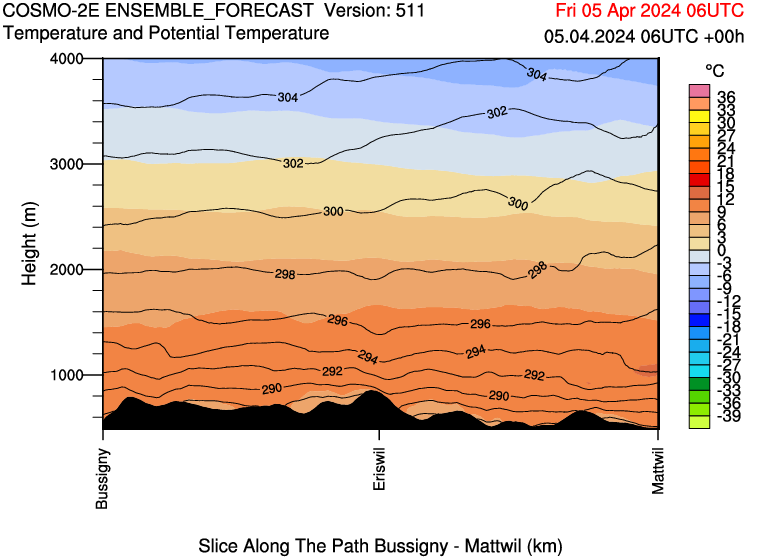
For the CLOUDLAB project we regularly get forecasts that contain a profile at the bottom of the figure from MeteoSwiss that illustrates the terrain nicely (albeit, sometimes it is missing for unknown reasons):
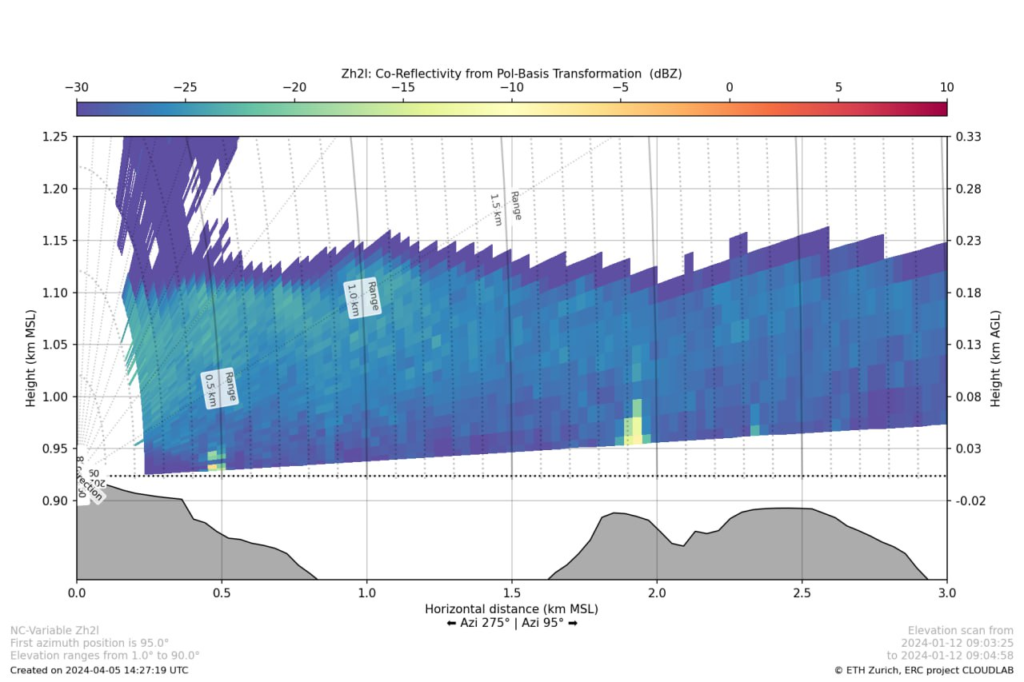
Similarly, I produced a lot of figures of our scans and depending on azimuth and elevation they may be affected by ground clutter, e.g. at a distance of 2 km the increased reflectivity is caused by the terrain below (the hill at around 800 m above sea level). As you can see, I added the terrain already.
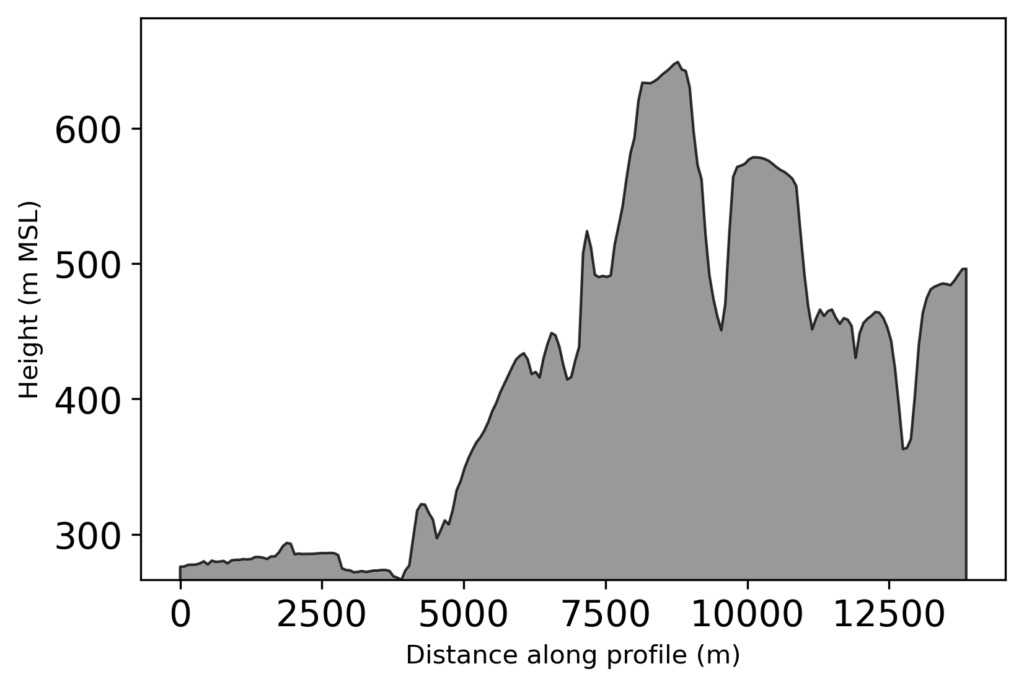
Initially, I thought I’d have to get the actual DEM for the area, find the path matching the scan direction and calculate the profile myself. While this might actually be a bit more accurate with a good DEM, it would be more work, not be transferable and mean I’d have to have extra data around. Instead, I realized that swisstopo offers the measure tool on map.geo.admin.ch and uses their own API with a matching request. So I choose to use this as I’m already adding the coordinates for the scan and it is relatively straightforward (min/max of lowest elevation scanline) to get the path we need. The main issue I faced was a misformatted quote that came from copy-pasting the swisstopo example. After finally figuring this out after a detailed URL decode and string comparison the function is relatively lean and can use either the JSON or the CSV backend of the API and by default gives you out a numpy array which can be visualized with ease and can look as follows:
I hope this helps someone to get a profile to enrich their Python (or other) graphs when measuring in Switzerland. In the likely case that you aren’t doing something in Switzerland it might be worthwhile to check out the Google Maps Elevation API (for which you need an API key and billing enabled)
Sample the OTT Parsivel2 on a Linux device via Python and output data as ASDO-CSV and/or netCDF4 by using this code:
Python
#!/bin/python3import osimport timeimport datetimeimport serialimport subprocessimport numpy as npimport netCDF4 as ncclassparsivel_via_serial(serial.Serial):def__init__(self,# serial port parameters# moxa is created as virtual USB0# to setup most likely the RS-485 2W has to be activated# by running# setserial /dev/ttyUSB0 port 1# for this to work, and also this program, the user than runs# this file the user needs to be in the dialout group (for fedora),# which can be done via the command:# sudo usermod -a -G dialout $USER# BE AWARE, a logout/reboot may be required port='/dev/ttyUSB0', baudrate =57600, ncmeta={'Station_Name': 'Eriswil (Kt. Bern, Switzerland)','latitude': 47.07051,'longitude': 7.87254,'altitude': 921,'Sensor_ID': 411994,'Title': 'CLOUDLAB (cloudlab.ethz.ch) disdrometer data from OTT Parsivel-2','Institution': 'ETH Zurich','Contact': "Jan Henneberger, janhe@ethz.ch;\n\ Robert Spirig, rspirig@ethz.ch;\n\ Fabiola Ramelli, ramellif@ethz.ch","Author": 'Robert Spirig, rspirig@ethz.ch', }, outpath='./', stationname='Eriswil', quiet=True, ):# cmd = ['setserial','/dev/ttyUSB0', 'port', '1'] res = subprocess.call(cmd)print(f'{cmd} call resulted in {res}')if res !=0:print('Setserial of the port to RS485-2W failed, ensure serialadapter is installed')return# inherit init from serial and open the portsuper().__init__(port=port, baudrate=baudrate)self.quiet = quiet# a bytebuffer to hold the answer from the parsivelself.buffer =b''# how to decode the bytes to a sensible string, generally UTF8 is preferedself.codec ='utf-8'# what to ask the parsivel, PA is the easiest, even if it is more than requiredself.pollcmd =b'CS/PA\r'# usual pollcmd for user telegram would be CS/P\r#pollcmd = b"CS/P\r"# for automatic polling, the time resolution in secondsself.samplinginterval =10# when to stop sampling, can be synced with crontab# and defaults to 15 minutesself.maxsampling =60*15# where to store the dataself.outpath = outpath# the prefix for the file to be usedself.fileprefix ='parsivel_'self.stationname = stationname[:10]# holder for current file, will be filled by subroutinesself.ncfile =''self.csvfile =''# holder for all written files, will be filled by subroutinesself.csvfiles = []self.ncfiles = []# dict to hold data order by variableself.data = {'-1': []}# to keep track of whether we expect data in the bufferself.polled =False# for waiting a tenth of a second for new bytes in the bufferself.waitdt =0.1# to keep track of the waiting timeself.waittime =0# the upper limit of waitingself.maxwait =3# increment buffersize to hold more than one record, maybe uselessself.ReadBufferSize =2**16;# default output order, ASDO compatibleself.csvoutputorder = ['21','20', '01', '02', '03', '05', '06', '07','08', '10', '11', '12', '16', '17', '18', '34', '35', '93']# default output header, ASDO compatibleself.csvheader = ['Date', 'Time', 'Intensity of precipitation (mm/h)', 'Precipitation since start (mm)', 'Weather code SYNOP WaWa',]self.csvheader += ['Weather code METAR/SPECI', 'Weather code NWS', 'Radar reflectivity (dBz)', 'MOR Visibility (m)', ]self.csvheader += ['Signal amplitude of Laserband', 'Number of detected particles', 'Temperature in sensor (°C)', ]self.csvheader += ['Heating current (A)', 'Sensor voltage (V)', 'Optics status', 'Kinetic Energy', 'Snow intensity (mm/h)', 'Spectrum']# add meta info forr ncfileself.ncmeta = {'Source': 'OTT Parsivel-2 optical disdrometer','History': 'Data acquired with MOXA USB converter','Dependencies': 'external','Conventions': 'CF-1.6 where applicable','Comment': "Manual of the OTT Parsivel-2 can be found online" \" at https://www.ott.com","Licence": "For non-commercial use only. Any usage of the data"\" should be reported to the contact person(s).", }self.ncmapping = {'09': 'interval','25': 'error_code','16': 'I_heating','17': 'V_sensor','18': 'state_sensor','10': 'sig_laser','01': 'rainfall_rate',#'02': 'RR_total','03': 'synop_WaWa','04': 'synop_WW','07': 'radar_reflectivity','08': 'visibility','12': 'T_sensor','11': 'n_particles',#'24': 'RR_accum','34': 'E_kin','90': 'number_concentration','91': 'fall_velocity','93': 'data_raw', }self.nctransformation = {'01': lambda x: x *60*60/1000,'12': lambda x: x +273.15, }# add any other information from ncmetafor key, value in ncmeta.items():#if key.lower() in ['name', 'location']:# key = f'Station_{key}'self.ncmeta[key] = valueifnotself.isOpen:self.open()self.flush()def__del__(self):self.close() time.sleep(1)defsettime(self):ifnotself.isOpen:self.open() time.sleep(1) time.sleep(0.2) now = datetime.datetime.now(datetime.UTC) cmd =b'CS/T/'+bytes(now.strftime('%H:%M:%S\r').encode(self.codec))ifnotself.quiet:print('Sending settime command ', cmd) update =self.write(cmd)self.flush() time.sleep(2) answer =b''ifself.in_waiting >0: answer =self.read(size=self.in_waiting)print('Answer to settime from parsivel was ', answer)self.flush()return answer.strip(b'\r\nOK\r\n\n').decode(self.codec).strip()defgettime(self):ifnotself.isOpen:self.open() time.sleep(1) time.sleep(0.2) cmd =b'CS/T\r'ifnotself.quiet:print('Sending gettime command ', cmd) update =self.write(cmd)self.flush() time.sleep(2) answer =b''ifself.in_waiting >0: answer =self.read(size=self.in_waiting)print('Answer to gettime from parsivel was ', answer)self.flush()return answer.strip(b'\r\nOK\r\n\n').decode(self.codec).strip()defsetdate(self):ifnotself.isOpen:self.open() time.sleep(1) time.sleep(0.2) now = datetime.datetime.now(datetime.UTC) cmd =b'CS/D/'+bytes(now.strftime('%d.%m.%Y\r').encode(self.codec))ifnotself.quiet:print('Sending setdate command to parsivel ', cmd) update =self.write(cmd)self.flush() time.sleep(2) answer =b''ifself.in_waiting >0: answer =self.read(size=self.in_waiting)print('Answer to setdate from parsivel was ', answer)self.flush()return answer.strip(b'\r\nOK\r\n\n').decode(self.codec).strip()defgetdate(self):ifnotself.isOpen:self.open() time.sleep(1) time.sleep(0.2) cmd =b'CS/D\r'ifnotself.quiet:print('Requesting date via ', cmd) update =self.write(cmd)self.flush() time.sleep(2) answer =b''ifself.in_waiting >0: answer =self.read(size=self.in_waiting)print('Answer to getdate from parsivel was ', answer)self.flush()return answer.strip(b'\r\nOK\r\n\n').decode(self.codec).strip()defsetrtc(self):ifnotself.isOpen:self.open() time.sleep(1) time.sleep(0.2) now = datetime.datetime.now(datetime.UTC) cmd =b'CS/U/'+bytes(now.strftime('%d.%m.%Y %H:%M:%S\r').encode(self.codec))ifnotself.quiet:print('Sending setrtc command', cmd) update =self.write(cmd)self.flush() time.sleep(2) answer =b''ifself.in_waiting >0: answer =self.read(size=self.in_waiting)print('Answer to setrtc from parsivel was ', answer)self.flush()return answer.strip(b'\r\nOK\r\n\n').decode(self.codec).strip()defgetrtc(self):ifnotself.isOpen:self.open() time.sleep(1) time.sleep(0.2) cmd =b'CS/U\r'ifnotself.quiet:print('Sending getrtc command to parsivel ', cmd) update =self.write(cmd)self.flush() time.sleep(2) answer =b''ifself.in_waiting >0: answer =self.read(size=self.in_waiting)print('Answer to getrtc from parsivel was ', answer)self.flush()return answer.strip(b'\r\nOK\r\n\n').decode(self.codec).strip()defsetstationname(self):ifnotself.isOpen:self.open() time.sleep(1) time.sleep(0.2)# max of 10 letter allowed sname =self.stationname[:10] cmd =b'CS/K/'+bytes(sname.encode(self.codec))ifnotself.quiet:print('Sending setstationname command to parsivel', cmd) update =self.write(cmd)self.flush() time.sleep(2) answer =b''ifself.in_waiting >0: answer =self.read(size=self.in_waiting)print('Answer to setstationname ({sname}) from parsivel was', answer)self.flush()return answer.strip(b'\r\nOK\r\n\n').decode(self.codec).strip()defgetstationname(self):ifnotself.isOpen:self.open() time.sleep(1) time.sleep(0.2)# max of 10 letter allowed sname =self.stationname[:10] cmd =b'CS/K\r'ifnotself.quiet:print('Sending getstationname command to parsivel', cmd) update =self.write(cmd)self.flush() time.sleep(2) answer =b''ifself.in_waiting >0: answer =self.read(size=self.in_waiting)print('Answer to getstationname from parsivel was ', answer)self.flush()return answer.strip(b'\r\nOK\r\n\n').decode(self.codec).strip()defsetdatetime(self):ifnotself.isOpen:self.open() time.sleep(1)self.setrtc()self.setdate()self.settime()defsetup(self):ifnotself.isOpen:self.open() time.sleep(1)#sname = self.getstationname()self.setstationname()self.setdatetime()self.flush()defpollcode(self, code):ifnotself.isOpen:self.open() time.sleep(1)self.flush()self.clearbuffer() thispollcmd =str(code)ifint(thispollcmd) >=90: delim =';' sleeptime =1else: delim ='' sleeptime =1 thispollcmd = (thispollcmd+delim).encode(self.codec) pollcmd =b'CS/R/'+bytes(thispollcmd)+b'\r\n' written =self.write(pollcmd)#self.flush()# according to manual there is a guarantee that the parsivel answers within 500 ms# so we wait here to ensure the buffer is full time.sleep(sleeptime)self.polled =Truewhileself.in_waiting ==0orself.waittime <= sleeptime: time.sleep(self.waitdt)self.waittime +=self.waitdtifself.waittime >self.maxwait:ifnotself.quiet:print(f'Breaking out of waiting for answer on serial as no data arrived after {self.maxwait} seconts!!!')break answer =''ifself.in_waiting >0: answer =self.read_until() #size=self.in_waiting) answer = answer.decode(self.codec)self.flush()self.polled =Falsereturn answerdefhelp(self):ifnotself.isOpen:self.open() time.sleep(1)self.flush()self.clearbuffer() pollcmd =b'CS/?\r\n' written =self.write(pollcmd)self.flush()# according to manual there is a guarantee that the parsivel answers within 500 ms# so we wait here to ensure the buffer is full time.sleep(1)whileself.in_waiting ==0orself.waittime <=0.5: time.sleep(self.waitdt)self.waittime +=self.waitdtifself.waittime >self.maxwait:ifnotself.quiet:print(f'Breaking out of waiting for answer on serial as no data arrived after {self.maxwait} seconts!!!')break answer =''ifself.in_waiting >0: answer =self.read(size=self.in_waiting) answer = answer.decode(self.codec)print(answer)defgetconfig(self):ifnotself.isOpen:self.open() time.sleep(1)self.clearbuffer() pollcmd =b'CS/L\r' written =self.write(pollcmd)# according to manual there is a guarantee that the parsivel answers within 500 ms# so we wait here to ensure the buffer is full time.sleep(0.5)whileself.in_waiting ==0orself.waittime <=0.5: time.sleep(self.waitdt)self.waittime +=self.waitdtifself.waittime >self.maxwait:ifnotself.quiet:print(f'Breaking out of waiting for answer on serial as no data arrived after {self.maxwait} seconts!!!')break answer =''ifself.in_waiting >0: answer =self.read(size=self.in_waiting) answer = answer.decode(self.codec)#answer = answer.split('\r\n')print(answer)return answerdefpoll(self):ifnotself.isOpen:self.open() time.sleep(1)self.flush()self.clearbuffer() written =self.write(self.pollcmd)# according to manual there is a guarantee that the parsivel answers within 500 ms# so we wait here to ensure the buffer is full time.sleep(0.5)self.polled =Truedefclearbuffer(self):# reset buffer in any caseself.buffer =b''defcleardata(self):# cleanup data dict after we've written out everything usuallyself.data = {'-1': []}defclear(self):self.clearbuffer()self.cleardata()defvelocity_classes(self):""" Return arrays of relevant velocity classes for use with TROPOS nc. Hardcoded velocity bins of parsivel are used to construct: 1. velocitybin The sizes as lower -> upper edge 2. velocities as the the average velocity of a bin 3. the raw_velocities that have been used to construct the above 2 Returns ------- velocitybin : array of float The droplet sizes . velocities : array of float The bin widths as difference to lower and upper edge for each bin. raw_velocities : array of float The bin widths (raw as per manual). """ raw_velocities = [0.0] + \ [0.1] *10+ \ [0.2] *5+ \ [0.4] *5+ \ [0.8] *5+ \ [1.6] *5+ \ [3.2] *2 velocities = np.asarray([(raw_velocities[i] + raw_velocities[i +1])/2for i inrange(len(raw_velocities[:-1]))]) velocitybin = np.cumsum(velocities)return velocitybin, velocities, np.asarray(raw_velocities)defdiameter_classes(self, asmeters=True):""" Return arrays of relevant diameter classes for use with TROPOS nc. Hardcoded bin widths of parsivel are used to construct: 1. dropletsizes The sizes as lower -> upper edge 2. dropletwidth as the the average of upper/lower edge 3. the sizes that have been used to construct the above 2 Returns ------- dropletsizes : array of float The droplet sizes . dropletwidths : array of float The bin widths as difference to lower and upper edge for each bin. raw_dropletwidths : array of float The bin widths (raw as per manual). """ raw_dropletwidths = [0.0] + \ [0.125] *10+ \ [0.250] *5+ \ [0.500] *5+ \ [1] *5+ \ [2] *5+ \ [3] *2 dropletwidths = [(raw_dropletwidths[i]+raw_dropletwidths[i+1])/2for i inrange(len(raw_dropletwidths[:-1]))] dropletsizes = np.cumsum(dropletwidths)if asmeters: scaling =1000else: scaling =1return dropletsizes / scaling, np.asarray(dropletwidths) / scaling, np.asarray(raw_dropletwidths) / scaling# max sampling time in seconds (to be restarted by cronjobdefsample(self, writeoutfreq=None):self.setup()if writeoutfreq isNone: writeoutfreq =self.samplingintervalif writeoutfreq %self.samplinginterval !=0:print(f'Writoutfreq has been adjusted to be the lower multiple of the samplinginterval {self.samplinginterval}') writeoutfreq = (writeoutfreq //self.samplinginterval) *self.samplinginterval parsivel.reset_input_buffer() time.sleep(1) curdt =0try:while curdt <=self.maxsampling orself.maxsampling <0: parsivel.getparsiveldata()#if curdt % 60 == 0:if curdt % writeoutfreq ==0: parsivel.write2file() time.sleep(self.samplinginterval) curdt +=self.samplingintervalexcept serial.SerialException:print('Issue with serial connection encounted, rerun...')exceptKeyboardInterrupt:print('Sampling interrupted.')defgetparsiveldata(self):ifnotself.isOpen:self.open() now = datetime.datetime.now(datetime.UTC)self.flush() time.sleep(0.1)ifnotself.polled:self.poll()whileself.in_waiting >0orself.waittime <=0.6:self.buffer +=self.read(size=self.in_waiting) curbytes =self.in_waiting time.sleep(self.waitdt)self.waittime +=self.waitdtifself.waittime >self.maxwait:ifnotself.quiet:print(f'Breaking out of waiting for answer on serial as no data arrived after {self.maxwait} seconds!!!')break# since we check after the time.sleep we can assume if there is nothing new that we are doneif curbytes ==self.in_waiting and curbytes <1:ifnotself.quiet:print(f'Breaking out of waiting for answer on serial as no new data has arrived after one more time step of {self.waitdr} after {self.waittime}!')breakelse:iflen(self.buffer) ==0:ifnotself.quiet:print(f'No bytes were available to read after {self.maxwait} seconds and we waited {self.waittime} seconds for an answer. ')eliflen(self.buffer) >1:ifnotself.quiet:print(f'{len(self.buffer)} bytes have been read in {self.waittime} seconds. ')else:passifnotself.quiet:print('Received the following answer to poll:\n', self.buffer)self.waittime =0self.polled =False# convert to sensible string record =self.buffer.strip(b'\x03').decode(self.codec).strip()# get different fields into list record = record.split('\r\n')# split into measurement value key and measurement value# the default return is CODE (2 Letters): data (until prev. removed \r\n record = {i[:2]: i[3:].rstrip(';').strip() for i in record[1:]}for key, value insorted(record.items()):# maintenance codesif key in ['94', '95', '96', '97', '98', '99']:continue# build up the dict to hold the available dataif key notinself.data:self.data[key] = []# date, time, software versions that should not be converted# as well as synop codes, sensor date/time and measuring start # as we handle these ourselvesif key in ['20', '21', '14', '15', '05', '06', '19', '21', '22']:pass# spectra dataelif key in ['90', '91', '93']: value = value.replace('000','')if value.count(';') ==len(value): value = np.zeros((32, 32))else:# spectra numbers are intif key in ['93']: value = [int(i) if i else0for i in value.split(';')]# others are floatelif key in ['90', '91']: value = [float(i) if i else0for i in value.split(';')] value = np.asarray(value)if key in ['93']:try: value = value.reshape(32, 32)exceptValueError:print(value.shape)# fake data of the right format as apparently the serial comm was interruped# this is usually the case if the script is running as several instance _value = np.zeros((32,32)) value = _value.flatten()[:len(value)] + valueelse:# floatif'.'in value and value.count('.') ==1: value =float(value)else:# maybe integer?try: value =int(value)# neither float nor integer, maybe a weather code, like wawaexceptValueError:print(f'Conversion to int failed for {value}, based on {key}')passself.data[key] += [value]# replace sensor time with system time# 21 = date, 20 = timeif'20'inself.data and'21'inself.data:self.data['21'][-1] = now.strftime('%d.%m.%Y')self.data['20'][-1] = now.strftime('%H:%M:%S')# keep unix time seperateself.data['-1'] += [datetime.datetime.timestamp(now)]else:print(f'Issue with sampling as no date or time was passed in the serial buffer, skipping {now} and cleaning up buffer')print(record, self.data)for key, value insorted(record.items()):if (self.data[key]) >=1:self.data[key].pop()# cleanup buffer in any caseself.clearbuffer()defwrite2file(self, *args, **kwargs):self.write2asdofile(*args, **kwargs)self.write2ncfile(*args, **kwargs)self.clear()def_setupncfile(self):if os.path.exists(self.ncfile): nchandle = nc.Dataset(self.ncfile, 'a', format='NETCDF3_CLASSIC')return nchandleifnotself.quiet:print(f'Setting up {outfile}') nchandle = nc.Dataset(self.ncfile, 'w', format='NETCDF3_CLASSIC') nchandle.createDimension('time', None) nchandle.createDimension('diameter', 32) nchandle.createDimension('velocity', 32) nchandle.createDimension('nv', 2)for key, value inself.ncmeta.items():setattr(nchandle, key, value) now = datetime.datetime.now(datetime.UTC)setattr(nchandle, "Processing_date", str(datetime.datetime.now(datetime.UTC)) +' (UTC)') datavar = nchandle.createVariable('lat', 'd', ())setattr(datavar, 'standard_name', 'latitude')setattr(datavar, 'long_name', 'Latitude of instrument location')setattr(datavar, 'units', 'degrees_north') datavar.assignValue(self.ncmeta['latitude']) datavar = nchandle.createVariable('lon', 'd', ())setattr(datavar, 'standard_name', 'longitude')setattr(datavar, 'long_name', 'Longitude of instrument location')setattr(datavar, 'units', 'degrees_east') datavar.assignValue(self.ncmeta['longitude']) datavar = nchandle.createVariable('zsl', 'd', ())setattr(datavar, 'standard_name', 'altitude')setattr(datavar, 'long_name','Altitude of instrument sensor above mean sea level')setattr(datavar, 'units', 'm') datavar.assignValue(self.ncmeta['altitude']) datavar = nchandle.createVariable('time', 'i', ('time',))setattr(datavar, 'standard_name', 'time')setattr(datavar, 'long_name','Unix time at start of data transfer in seconds after 00:00 UTC on 1/1/1970')setattr(datavar, 'units', 'seconds since 1970-01-01 00:00:00')setattr(datavar, 'bounds', 'time_bnds')setattr(datavar, 'comment','Time on data acquisition pc at initialization of serial connection to Parsivel.') datavar = nchandle.createVariable('time_bnds', 'i', ('time', 'nv'))setattr(datavar, 'standard_name', 'Measurement interval bounds') # time_bndssetattr(datavar, 'long_name', 'Timespan of the measurement interval')setattr(datavar, 'units', 's')setattr(datavar, 'comment', 'Upper and lower bounds of measurement interval.') datavar = nchandle.createVariable('interval', 'i', ('time',))setattr(datavar, 'standard_name', 'Time interval') # intervalsetattr(datavar, 'long_name', 'Length of measurement interval')setattr(datavar, 'units', 's')setattr(datavar, 'comment','Variable 09 - Sample interval between two data retrieval requests.') diameters =self.diameter_classes() datavar = nchandle.createVariable('diameter', 'd', ('diameter',))setattr(datavar, 'standard_name', 'Particle diameter') # diametersetattr(datavar, 'long_name', 'Center diameter of precipitation particles')setattr(datavar, 'units', 'm')setattr(datavar, 'comment','Predefined diameter classes. Note the variable bin size.') datavar[:] = diameters[0] datavar = nchandle.createVariable('diameter_spread', 'd', ('diameter',))setattr(datavar, 'standard_name', 'Particle spread') # diameter spreadsetattr(datavar, 'long_name', 'Width of diameter interval')setattr(datavar, 'units', 'm')setattr(datavar, 'comment', 'Bin size of each diameter class.') datavar[:] = (diameters[1]) datavar = nchandle.createVariable('diameter_bnds', 'i', ('diameter', 'nv'))setattr(datavar, 'standard_name', 'Particle bounds') # diameter bndssetattr(datavar, 'long_name', 'Bounds of the diameter interval')setattr(datavar, 'units', 'm')setattr(datavar, 'comment', 'Upper and lower bounds of diameter interval.') datavar[:, :] = np.stack([np.cumsum(diameters[2][:-1]), np.cumsum(diameters[2][1:])]).T velocities =self.velocity_classes() datavar = nchandle.createVariable('velocity', 'd', ('velocity',))setattr(datavar, 'standard_name', 'Fall velocity') # velocsetattr(datavar, 'long_name','Center fall velocity of precipitation particles')setattr(datavar, 'units', 'm s-1')setattr(datavar, 'comment','Predefined velocity classes. Note the variable bin size.') datavar[:] = (velocities[0]) datavar = nchandle.createVariable('velocity_spread', 'd', ('velocity',))setattr(datavar, 'standard_name', 'Fall velocity spread') # vel spredsetattr(datavar, 'long_name', 'Width of velocity interval')setattr(datavar, 'units', 'm')setattr(datavar, 'comment', 'Bin size of each velocity interval.') datavar[:] = (velocities[1]) datavar = nchandle.createVariable('velocity_bnds', 'd', ('velocity', 'nv'))setattr(datavar, 'standard_name', 'Fall velocity bounds') # vel bndssetattr(datavar, 'comment', 'Upper and lower bounds of velocity interval.') datavar[:, :] = np.stack([np.cumsum(velocities[2][:-1]), np.cumsum(velocities[2][1:])]).T datavar = nchandle.createVariable('data_raw', 'd', ('time', 'diameter', 'velocity',), fill_value=-999.)setattr(datavar, 'standard_name', 'Particle count per velocity and diameter bin') # data_rawsetattr(datavar, 'long_name','Raw Data as a function of particle diameter and velocity')setattr(datavar, 'units', '1')setattr(datavar, 'comment', 'Variable 93 - Raw data.') datavar = nchandle.createVariable('number_concentration', 'd', ('time', 'diameter',), fill_value=-999.)setattr(datavar, 'standard_name', 'Total particle count in time interval') # n_particlessetattr(datavar, 'long_name', 'Number of particles per diameter class')setattr(datavar, 'units', 'log10(m-3 mm-1)')setattr(datavar, 'comment', 'Variable 90 - Field N (d)') datavar = nchandle.createVariable('fall_velocity', 'd', ('time', 'diameter',), fill_value=-999.)setattr(datavar, 'standard_name', 'Fall velocity') # radar reflsetattr(datavar, 'long_name', 'Average velocity of each diameter class')setattr(datavar, 'units', 'm s-1')setattr(datavar, 'comment', 'Variable 91 - Field v (d)') datavar = nchandle.createVariable('n_particles', 'i', ('time',))setattr(datavar, 'standard_name', 'Total particle count in time interval') # n particlessetattr(datavar, 'long_name', 'Number of particles in time interval')setattr(datavar, 'units', '#')setattr(datavar, 'comment', 'Variable 11 - Number of detected particles') datavar = nchandle.createVariable('rainfall_rate', 'd', ('time',), fill_value=-999.)setattr(datavar, 'standard_name', 'rainfall_rate')setattr(datavar, 'long_name', 'Precipitation rate')setattr(datavar, 'units', 'm s-1')setattr(datavar, 'comment', 'Variable 01 - Rain intensity (32 bit) 0000.000') datavar = nchandle.createVariable('radar_reflectivity', 'd', ('time',), fill_value=-999)setattr(datavar, 'standard_name', 'equivalent_reflectivity_factor')setattr(datavar, 'long_name', 'equivalent radar reflectivity factor')setattr(datavar, 'units', 'dBZ')setattr(datavar, 'comment', 'Variable 07 - Radar reflectivity (32 bit).') datavar = nchandle.createVariable('E_kin', 'd', ('time',), fill_value=-999.)setattr(datavar, 'standard_name', 'Kinetic energ') # ekinsetattr(datavar, 'long_name', 'Kinetic energy of the hydrometeors')setattr(datavar, 'units', 'kJ')setattr(datavar, 'comment', 'Variable 24 - kinetic Energy of hydrometeors.') datavar = nchandle.createVariable('visibility', 'i', ('time',), fill_value=-999)setattr(datavar, 'standard_name', 'Visibility') # visisetattr(datavar, 'long_name', 'Visibility range in precipitation after MOR')setattr(datavar, 'units', 'm')setattr(datavar, 'comment','Variable 08 - MOR visibility in the precipitation.') datavar = nchandle.createVariable('synop_WaWa', 'i', ('time',), fill_value=-999)setattr(datavar, 'standard_name', 'Synop Code WaWa') # synop wawasetattr(datavar, 'long_name', 'Synop Code WaWa')setattr(datavar, 'units', '1')setattr(datavar, 'comment','Variable 03 - Weather code according to SYNOP wawa Table 4680.') datavar = nchandle.createVariable('synop_WW', 'i', ('time',), fill_value=-999)setattr(datavar, 'standard_name', 'Synop Code WW') # synop wwsetattr(datavar, 'long_name', 'Synop Code WW')setattr(datavar, 'units', '1')setattr(datavar, 'comment','Variable 04 - Weather code according to SYNOP ww Table 4677.') datavar = nchandle.createVariable('T_sensor', 'i', ('time',), fill_value=-999)setattr(datavar, 'standard_name', 'Temperature') # T_sensorsetattr(datavar, 'long_name', 'Temperature in the sensor')setattr(datavar, 'units', 'K')setattr(datavar, 'comment', 'Variable 12 - Temperature in the Sensor') datavar = nchandle.createVariable('sig_laser', 'i', ('time',))setattr(datavar, 'standard_name', 'Laser signal amplitude') # sig_lasersetattr(datavar, 'long_name', 'Signal amplitude of the laser')setattr(datavar, 'units', '1')setattr(datavar, 'comment','Variable 10 - Signal ambplitude of the laser strip') datavar = nchandle.createVariable('state_sensor', 'i', ('time',))setattr(datavar, 'standard_name', 'State of the Sensor') # v_sensorsetattr(datavar, 'long_name', 'State of the Sensor')setattr(datavar, 'units', '1')setattr(datavar, 'comment', 'Variable 18 - Sensor status:\n'\'0: Everything is okay.\n' \'1: Dirty but measurement possible.\n'\'2: No measurement possile') datavar = nchandle.createVariable('V_sensor', 'd', ('time',))setattr(datavar, 'standard_name', 'Sensor Voltage') # v_sensorsetattr(datavar, 'long_name', 'Sensor Voltage')setattr(datavar, 'units', 'V')setattr(datavar, 'comment', 'Variable 17 - Power supply voltage in the sensor.') datavar = nchandle.createVariable('I_heating', 'd', ('time',))setattr(datavar, 'standard_name', 'Heating Current') # I_heatingsetattr(datavar, 'long_name', 'Heating Current')setattr(datavar, 'units', 'A')setattr(datavar, 'comment', 'Variable 16 - Current through the heating system.') datavar = nchandle.createVariable('error_code', 'i', ('time',))setattr(datavar, 'standard_name', 'Error code') # Errors codessetattr(datavar, 'long_name', 'Error Code')setattr(datavar, 'units', '1')setattr(datavar, 'comment', 'Variable 25 - Error code.')return nchandledefwrite2ncfile(self, intosubdirs=True, ):ifself.data and'21'inself.data:passelse:ifnotself.quiet:print('No data have been read yet. Call getparsiveldata() first.')returnifnotself.outpath.endswith(os.sep):self.outpath += os.sep os.makedirs(self.outpath, exist_ok=True)if'21'inself.data:passelse:print('No records to write yet in self.data')returnif'21'inself.data andlen(self.data['21']) >0:passelse:print('No records to write yet in self.data')return udays =sorted(list(set(self.data['21'])))for day in udays:if intosubdirs: ymd = day.split('.')[::-1] ymd = [i + j for i, j inzip(['Y', 'M', 'D'], ymd)] _outpath =self.outpath+os.sep.join(ymd)+os.sep os.makedirs(_outpath, exist_ok=True)else: _outpath =self.outpath# day has the format d.m.Y but we want the filename to be Ymd outfile =self.fileprefix +''.join(day.split('.')[::-1]) +'.nc'self.ncfile = _outpath + outfile nchandle =self._setupncfile()setattr(nchandle, 'Date', day) index_of_day = [i[0] for i inenumerate(self.data['21']) if i[1] == day] curtimestep = nchandle.dimensions['time'].size unixtime = ([self.data['-1'][i] for i in index_of_day]) nchandle.variables["time"][curtimestep] = (unixtime) bnds = [[self.data['-1'][i] -int(self.data['09'][i]), self.data['-1'][i]] for i in index_of_day] nchandle.variables['time_bnds'][curtimestep, :] = (bnds) varNames = nchandle.variables.keys()for ncvar inself.ncmapping: thisvar = nchandle.variables[self.ncmapping[ncvar]] thisdata = [self.data[ncvar][i] for i in index_of_day]if ncvar inself.nctransformation: thisdata = [self.nctransformation[ncvar](i) for i in thisdata]iflen(thisvar.shape) ==1: thisvar[curtimestep] = (thisdata)eliflen(thisvar.shape) ==2: thisvar[curtimestep, :] = (thisdata)eliflen(thisvar.shape) ==3: thisdata = np.asarray(thisdata).reshape(thisvar.shape[1:]) thisvar[curtimestep, :, :] = (thisdata) nchandle.close() now = datetime.datetime.now(datetime.UTC)print(f'Written {len(index_of_day)} records of data to {self.ncfile} at {now}')self.ncfiles =list(set(self.ncfiles+[self.ncfile]))pass# order can be anything, but defaults to ASDO format, see header in below functiondefwrite2asdofile(self, intosubdirs=True, varorder=[], header=[]):assertlen(varorder) ==len(header), 'Order of variables and header have to match'ifself.data:passelse:print('No data have been read yet. Call getparsiveldata() first.')returnif varorder:self.csvoutputorder = varorderif header:self.csvheader = headerifnotself.outpath.endswith(os.sep):self.outpath += os.sep os.makedirs(self.outpath, exist_ok=True) filemode ='a'# examples ASDO file#04.03.2023,00:00:00,0.000,216.57,0,NP,C,-9.999,20000,19866,0,-1,0.64,23.8,0,0.000,0,<SPECTRUM>ZERO</SPECTRUM>#2023.03.28,14:30:58,0.0,33.06,0,NP,C,-9.999,20000,21649,0,16,0.0,23.8,0,0.0,0.0,<SPECTRUM></SPECTRUM># 25.02.2023,00:05:30,3.100,210.07,62,RA,R,32.661,8290,16569,90,1,0.00,23.8,0,53.310,0,# <SPECTRUM>,,,,,,,,,,,,,,,,,,,,,,,,,,,,,,,,,,,,,,,,,,,,,,,,,,,,,,,,,,,,,,,,,,,,,,,,,,,,,,,,,,,,,,,,,,,,,,,,,,# ,,,,,,,,,,,,,,,,,,,,,,,,,,,,,,,,,,,,,,,,,,,,,,,,,,,,,,,,,,,,,,,,,,,,,,,,,,,,,,,,,,,,,,,,,,,,,,,,,,,,,,,,,,,,# ,,,,,,,,,,,,,,,,,,,,2,,,,,,,,,,,,,,,,,,,,,,,,,,,,,,,,,,,,,,,,,,,,,,,,,,,,,,,,,,,,,,,,,,,,,,,,,,,,,,,,,,,,,,,#,,,,,,,,,2,,,,,,,,,,,,,,,,,,,,,,,,,,,,,,,,1,1,,,,,,,,,,,,,,,,,,,,,,,,,,,,,,,1,,1,,,,,,,,,,,,,,,,,,,,,,,,,,,,,#,1,,1,,,,,,,,,,,,,,,,,,,,,,,,,,,,,,,,1,,,,,,,,,,,,,,,,,,,,,,,,,,,,,,,,5,2,2,1,,,,,,,,,,,,,,,,,,,,,,,,,,,,,,1,#4,,,,,,,,,,,,,,,,,,,,,,,,,,,,,,1,1,5,,,,,,,,,,,,,,,,,,,,,,,,,,,,,,,,2,1,1,,,,,,,,,,,,,,,,,,,,,,,,,,,,,1,1,,3,#1,,,,,,,,,,,,,,,,,,,,,,,,,,,,,2,,4,10,7,,,,,,,,,,,,,,,,,,,,,,,,,,,,,,,3,8,3,,,,,,,,,,,,,,,,,,,,,,,,,,,,,,,,4,#2,,,,,,,,,,,,,,,,,,,,,,,,,,,,,,,,,2,,,,,,,,,,,,,,,,,,,,,,,,,,,,,,,1,,,,,,,,,,,,,,,,,,,,,,,,,,,,,,,,,,1,,,,,,,,,,,,#,,,,,,,,,,,,,,,,,,,,,,,,,,,,,,,,,,,,,,,,,,,,,,,,,,,,,,,,,,,,,,,,,,,,,,,,,,,,,,,,,,,,,,,,,,,,,,,,,,,,,,,,,,,,,,,,,,#,,,,,,,,,,,,,,,,,,,,,,,,,,,,,,,,,,,,,,,,,,,,,,,,,,,,,,,,,,,,,,,,,,,,,,,,,,,,,,,,,,,</SPECTRUM>if'21'inself.data:passelse:print('No records to write yet in self.data')returnif'21'inself.data andlen(self.data['21']) >0:passelse:print('No records to write yet in self.data')return udays =sorted(list(set(self.data['21'])))for day in udays:if intosubdirs: ymd = day.split('.')[::-1] ymd = [i + j for i, j inzip(['Y', 'M', 'D'], ymd)] _outpath =self.outpath+os.sep.join(ymd)+os.sep os.makedirs(_outpath, exist_ok=True)else: _outpath =self.outpath# day has the format d.m.Y but we want the filename to be Ymdself.csvfile =self.fileprefix +''.join(day.split('.')[::-1]) +'.csv' writeheader =True# write out the buffer to fileif os.path.exists(_outpath +self.csvfile): writeheader =False# maxtimesteps because self.data holds everything ntimesteps =len(self.data['20'])withopen(_outpath+self.csvfile, filemode) as fo:if writeheader: fo.write(','.join(self.csvheader)) fo.write('\n')for timestep inrange(ntimesteps):# skip if not the same dayifself.data['21'][timestep] != day:continuefor key inself.csvoutputorder: varrec =self.data[key][timestep]if key in'93': fo.write('<SPECTRUM>')if key in ['90', '91', '93']:ifnotisinstance(varrec, str): varrec =','.join([str(i) if i >0else''for i in varrec.flatten()])iflen(varrec) == varrec.count(','): varrec ='ZERO'else: varrec +=',' fo.write(str(varrec))if key in'93': fo.write('</SPECTRUM>')else: fo.write( ',') fo.write('\n')self.csvfiles =list(set(self.csvfiles+[self.csvfile]))ifnotself.quiet:print(f'Written {ntimesteps} records to {_outpath+self.outfile} for {day}')if__name__=='__main__': parsivel = parsivel_via_serial(outpath='./',)#parsivel.help()#parsivel.pollcode(33)#parsivel.pollcode(93)try: parsivel.sample()exceptKeyboardInterrupt:print('Sampling interrupted.')#time.sleep(1)#cfg = parsivel.getconfig()#print(cfg)#time.sleep(1)#curdt = 0#try:# while curdt <= maxdt :# parsivel.getparsiveldata()# #if curdt % 60 == 0:# parsivel.write2file()# time.sleep(dt)# curdt += dt#except serial.SerialException:# print('Issue with serial connection encounted, rerun...')# del parsivel#finally:# del parsivel
In my last project, I had to sample data coming via serial (RS482-2W) from an OTT Parsivel2. Initially, I connected it to a Windows laptop via a Moxa UPort-1150 serial to USB adapter and let ASDO do the sampling. However, I often ran into issues, namely that ASDO would simply crash. Restarting it would require me to remotely connect to the laptop, kill ASDO via task manager and restart it. Depending on how soon I realised the issue (usually the latest the next morning when I would receive an email) some hours to some days (when it happened on the weekend) of data would be gone as the device does not store data.
Eventually, I got fed up of this manual approach and decides to program my own solution and move the sampling to a Linux device (in this case the server as that is what I had available). While the USB adapter required drivers needed to be compiled first, once that was working I could now sample the Parsivel with the code linked on top. The sampling can be setup via cronjob – I choose every 15 minutes so that there is no risk of time divergence (setup set date and time of the parsivel and is called before sampling) and in case there are some serial buffer issues.
#!/usr/bin/env python3# -*- coding: utf-8 -*-"""Created on Wed Sep 15 09:22:30 2021@author: spirrobe"""import osimport datetimeimport requestsimport jsonclasschm15ksession(requests.Session):""" A class for interacting with the CHM-15k data server. This class inherits from the requests.Session class and is designed to facilitate downloading netCDF and zipped netCDF files from the CHM-15k. To use this class, you must have a valid password for accessing the server. Parameters ---------- url : str The URL of the CHM-15k ceilometer. Can be local ip or http URl password : str, optional The password for accessing the CHM-15k. Default is "15k-Nimbus". outpath : str, optional The path to save downloaded files to. Default is the current directory. download2subdirs : bool, optional Whether to put files into a subdirectory as outpath/{year}/{month}/{day} where year, month, day are inferred for each file based on the filename quiet : bool, optional Whether to print information about the download progress. Default is True. Attributes ---------- url : str The URL of the CHM-15k. session : requests.Session The requests session object used to communicate with the server. password : str The password for accessing the CHM-15k data server. outpath : str The path to save downloaded files to. filecount : bool The number of files available on the server. quiet : bool Whether to print information about the download progress. sessionid : str The ID of the current session with the server. zipfiles : list of str The names of the zipped netCDF files available on the server. zipsizes : list of int The sizes of the zipped netCDF files available on the server, in bytes. ncfiles : list of str The names of the netCDF files available on the server. ncsizes : list of int The sizes of the netCDF files available on the server, in bytes. Methods ------- connect() Connects to the CHM-15k data server and establishes a session. getfilelist() Returns a dictionary of available netCDF and zipped netCDF files on the CHM-15k data server. getncfiles(overwrite=False) Downloads all available netCDF files from the CHM-15k to the local file system. getzipfiles(overwrite=False) Downloads all available zipped netCDF files from the CHM-15k to the local file system. """def__init__(self,url,password="15k-Nimbus",outpath='./',download2subdirs=False,timeout=20,quiet=True,*args, **kwargs, ):""" Initialize a new instance of the chm15ksession class. Parameters ---------- url : str The URL of the CHM-15k. password : str, optional The password for accessing the CHM-15k data server. Default is "15k-Nimbus". outpath : str, optional The path to save downloaded files to. Default is the current directory. timeout : bool, optional The timeout in seconds for the get calls, adjust if on low bandwidth/slow network. quiet : bool, optional Whether to print information about the download progress. Default is True. """super().__init__(*args, **kwargs)# assert url, str, 'url must be a str'self.timeout = timeoutself.url = urlifnotself.url.endswith('/'):self.url +='/'ifnotself.url.startswith('http'):self.url ='http://'+self.urlself.__cgi ="cgi-bin/chm-cgi"self.__cgiurl =self.url +self.__cgi#self.session = requests.Session()#self = requests.Session()self.password = passwordself.outpath = outpathself.__subpath =''self.download2subdirs = download2subdirsifnotself.outpath.endswith(os.sep):self.outpath += os.sepself.filecount =Noneself.sessionid =Noneself.zipfiles = []self.zipsizes = []self.ncfiles = []self.ncsizes = []self.quiet = quietdef_filename2date(self, filename):# pattern is YYYYMMDD _ = filename.split(os.sep)[-1].split('_')[0]iflen(_) ==8:# typical netcdf filesreturn _[:4], _[4:4+2], _[4+2:4+2+2]eliflen(_) ==6:# zipfiles do not have a day as they are for the monthreturn _[:4], _[4:4+2]else:print(f'Date could not be inferred from {filename}')return'', '', ''def_filename2datefolder(self, filename): date =self._filename2date(filename)if date[0]: date = [s + i for s, i inzip(['Y','M','D'], date)] date = os.sep.join(date) + os.sepifnotself.outpath.endswith(os.sep): date = os.sep + datereturn dateelse:return''defconnect(self):""" Connect to the CHM-15k using the provided password. This method sends a validation request to the CHM-15k data server with the provided passwordand obtains a session ID that can be used for subsequent requests. Raises ------ requests.exceptions.RequestException If the request fails. """ validationurl =self.__cgiurl+f"?validatetoken&code={self.password}"# this url could be used to check if the connection worked# checkurl = self.__cgiurl+"?checkvalidation"try: resp =self.get(validationurl, timeout=self.timeout)except requests.exceptions.RequestException: now = datetime.datetime.now(datetime.UTC)print(f'{now}: Connection failed, check url {self.url} and 'f'password {self.password}')return sessionid = resp.text.strip().split('{')[1].split('}')[0] resp.close() sessionid = sessionid.split(':')[1].split(',')[0]self.sessionid = sessionidself.cookies.set("session", self.sessionid,domain=self.url.split(':')[1][2:])ifnotself.quiet: now = datetime.datetime.now(datetime.UTC)print(f'{now}: Connection successful to {self.url}')self.sessionid =Truedefgetfilelist(self):""" Get a list of files from the CHM-15k. If the connection to the server has not been established, this method will establish a connection. Sets attributes of the object to contain the return values as well. Returns ------- dict A dictionary containing the following keys: - 'zipfiles': A list of the names of zipped netCDF files. - 'netcdffiles': A list of the names of netCDF files. - 'zipsizes': A list of the sizes of zipped netCDF files. - 'ncsizes': A list of the sizes of netCDF files. """ifself.sessionid:passelse:self.connect() resp =self.get(self.__cgiurl +'?filelist', timeout=self.timeout) filelist = resp.text resp.close() filelist = filelist[filelist.index('{'):] filelist = filelist[:-filelist[::-1].index('}')]try: filelist = json.loads(filelist)except json.JSONDecodeError:ifnotself.quiet: now = datetime.datetime.now(datetime.UTC)print('{now}: Issue with getting proper filelist, aborting getfilelist and potential callers')returnNoneself.filecount = filelist['count']self.zipfiles = [i[0] for i in filelist["ncfiles"] if'zip'in i[0]]self.zipsizes = [i[1] for i in filelist["ncfiles"] if'zip'in i[0]]self.ncfiles = [i[0] for i in filelist["ncfiles"] if'zip'notin i[0]]self.ncsizes = [i[1] for i in filelist["ncfiles"] if'zip'notin i[0]]ifnotself.quiet: now = datetime.datetime.now(datetime.UTC)print(f'{now}: Found {filelist["count"]} files in total to be checked')print(f'{now}: Found {len(self.ncfiles)} netCDF files')print(f'{now}: Found {len(self.zipfiles)} zipped netCDF files')return {'zipfiles': self.zipfiles, 'netcdffiles': self.ncfiles,'zipsizes': self.zipsizes, 'ncsizes': self.ncsizes}defgetsinglefile(self, filename, overwrite=True):""" Download a single file from the CHM15k to the specified output path. Parameters ---------- filename : str Name of the file to be downloaded. Can be either zip or nc file. overwrite : bool, optional Flag indicating whether to overwrite the file if it already exists in the output path and has the same size. Defaults to True. Returns ------- None If the file is not available on the server or if the file transfer fails. Raises ------ None Notes ----- This method uses the requests library to download the file from the server, and saves it to the output path using the same filename as on the device. """ifself.filecount:passelse:self.getfilelist()if filename notinself.ncfiles or filename inself.zipfiles:print(f'File {filename} not available')returnelse:if filename inself.ncfiles: filesize =self.ncsizes[self.ncfiles.index(filename)]elif filename inself.zipfiles: filesize =self.zipsizes[self.zipfiles.index(filename)]else:print(f'File {filename} not available')returnifself.download2subdirs:self.__subpath =self._filename2datefolder(filename) os.makedirs(self.outpath +self.__subpath, exist_ok=True)# check if the file exists, and if it does has the same size# if so continueif os.path.exists(self.outpath +self.__subpath + filename): fs = os.path.getsize(self.outpath +self.__subpath + filename) //1024if fs == filesize andnot overwrite:ifnotself.quiet:print(f'File {filename} already exists and has the same ''size as the file on the CHM15k. Pass overwrite to','download anyway')return filecontent =self.get(self.__cgiurl+'/'+filename+"?getfile", timeout=self.timeout)# check if the transfer worked in the firstplace, if not continueif filecontent.status_code !=200:ifnotself.quiet: now = datetime.datetime.now(datetime.UTC)print(f'{now}: Filetransfer failed for {filename}')returnwithopen(self.outpath +self.__subpath + filename, 'wb') as fo: fo.write(filecontent.content)ifnotself.quiet: now = datetime.datetime.now(datetime.UTC)print(f'{now}: Successfully downloaded {filename}')self.__subpath =''defgetncfiles(self, overwrite=False):""" Download netCDF files from the CHM-15k to the specified `outpath`. Parameters ---------- overwrite : bool, optional Whether to overwrite existing files with the same name and size in the `outpath`. Default is False. Raises ------ ValueError If `filecount` attribute is False. Notes ----- This method first checks whether the `filecount` attribute is set. If not, it calls the `getfilelist` method to obtain a list of files available for download. Then, for each netCDF file in the list, it checks whether the file already exists in the `outpath` and has the same size as the file. If not, it downloads the file using a GET request and saves it to the `outpath`. """ifself.filecount:passelse:self.getfilelist() dlcount =0for fileno, (filename, filesize) inenumerate(zip(self.ncfiles, self.ncsizes)):ifself.download2subdirs:self.__subpath =self._filename2datefolder(filename)# check if the file exists, and if it does has the same size# if so continueif os.path.exists(self.outpath +self.__subpath + filename): fs = os.path.getsize(self.outpath +self.__subpath + filename) //1024if fs == filesize andnot overwrite:ifnotself.quiet: now = datetime.datetime.now(datetime.UTC)print(f'Not downloading {filename} as it exists and has the same size')print(f'{now}: Progress at ',f'{round((fileno+1)/len(self.ncfiles) *100,1)} %')continueelse: os.makedirs(self.outpath +self.__subpath, exist_ok=True) filecontent =self.get(self.__cgiurl+'/'+filename+"?getfile", timeout=self.timeout)# check if the transfer worked in the firstplace, if not continueif filecontent.status_code !=200:ifnotself.quiet:print(f'Filetransfer failed for {filename}')continuewithopen(self.outpath +self.__subpath + filename, 'wb') as fo: fo.write(filecontent.content)ifnotself.quiet: now = datetime.datetime.now(datetime.UTC)print(f'{now}: Successfully downloaded {filename}, the {dlcount+1} file')print(f'{now}: Progress at 'f'{round((fileno+1)/len(self.ncfiles) *100,1)} %') dlcount +=1 now = datetime.datetime.now(datetime.UTC)print(f'{now}: Downloaded all {dlcount} files that contained new data 'f'to {self.outpath +self.__subpath}')self.__subpath =''defgetzipfiles(self, overwrite=False):""" Download zip files from the CHM-15k to the specified `outpath`. Parameters ---------- overwrite : bool, optional Whether to overwrite existing files with the same name and size in the `outpath`. Default is False. Raises ------ ValueError If `filecount` attribute is False. Notes ----- This method first checks whether the `filecount` attribute is set. If not, it calls the `getfilelist` method to obtain a list of files available for download. Then, for each zip file in the list, it checks whether the file already exists in the `outpath` and has the same size as the file. If not, it downloads the file using a GET request and saves it to the `outpath`. """ifself.filecount:passelse:self.getfilelist() os.makedirs(self.outpath, exist_ok=True)for fileno, (filename, filesize) inenumerate(zip(self.zipfiles, self.zipsizes)):ifself.download2subdirs:self.__subpath =self._filename2datefolder(filename)# check if the file exists, and if it does has the same size# if so continueif os.path.exists(self.outpath +self.__subpath + filename): fs = os.path.getsize(self.outpath +self.__subpath + filename) //1024if fs == filesize andnot overwrite:ifnotself.quiet:print('File already exists and has 'f'the same size ({filename})')continueelse: os.makedirs(self.outpath +self.__subpath, exist_ok=True) filecontent =self.get(self.__cgiurl+'/'+filename+"?getfile", timeout=self.timeout)# check if the transfer worked in the firstplace, if not continueif filecontent.status_code !=200:ifnotself.quiet:print(f'Filetransfer failed for {filename}')continuewithopen(self.outpath +self.__subpath + filename, 'wb') as fo: fo.write(filecontent.content)ifnotself.quiet: now = datetime.datetime.now(datetime.UTC)print(f'{now}: Successfully downloaded {filename}')print(f'{now}: Progress at 'f'{round((fileno+1)/len(self.zipfiles) *100,1)} %') now = datetime.datetime.now(datetime.UTC)print(f'{now}: Downloaded all {len(self.zipfiles)} available 'f'zip files at {self.outpath +self.__subpath}')self.__subpath =''if__name__=='__main__': url =''# the url to connect to, either http/s or ip directly of the chm15k a = chm15ksession(urloutpath='./',quiet=False)# establish a connection, setting up a session, this wil be done automatically# upon calling other get functions a.connect()# get the available files in case you want to download only one file a.getfilelist()# usually, one is interested only in the netcdf files that are available,# especially in an operational setting where other files have already# been downloaded. # per default, existing files are not downloaded again# a.getncfiles()# zipfiles are created by the device for each month and can be downloaded as well# per default, existing files are not downloaded again# a.getzipfiles()
Background & motivation
The CHM15k offers the choice between serial and ethernet connection to sample data. While serial connections are true and tested, especially with data logger the reality might be that you don’t have one on-site, its serial ports are full or you would need a USB to serial adapter (which can be quite bothersome with Linux machines. We actually do sample a Parsivel2 with our data server at the CLOUDLAB field site which requires frequent self-compiled drivers as we are running Fedora with its frequent kernel updates….
So we choose to go via the web interface of the Lufft CHM15k even though it requires a login. The upside is that checking for missing data is quite straightforward, it can be interactive and if you forward ports to its network correctly you can also sample it from the outside.
For this purpose, I had a look with the browser inspection tool to see what is being done when the password is sent and used the requests session to stay validated. The rest is fairly standard file checking and downloading. The above allows the script to be changed once with the correct URL (can be the IP or similar, including a port of course). Be aware that you should probably (really really) change the password if you make your device world-accessible via port forwarding.
Once that is done you can run the file via a cronjob or task scheduler as many times as you want as only most recent files are downloaded. Alternatively, import the class and check functionalities yourself for downloading single files or similar. Hope this helps someone out there to facilitate sampling via their ceilometer